Deciding how many plants will fit in your garden bed is often one of the hardest parts of starting a garden.
You might buy seedlings or seeds, see the empty space, and wonder how close together to plant them. Are you planting too many or too few? Understanding plants per square meter helps you make the right choice. It’s not always obvious.
This choice matters. If plants are too close, they might not grow well and could get sick. If they’re too far apart, you waste space. Plants need enough air and sunlight to stay healthy.
By the end, you’ll know how to calculate plants per square meter, use easy charts, and plan your garden with confidence.
What Does Plants per Square Meter Mean?
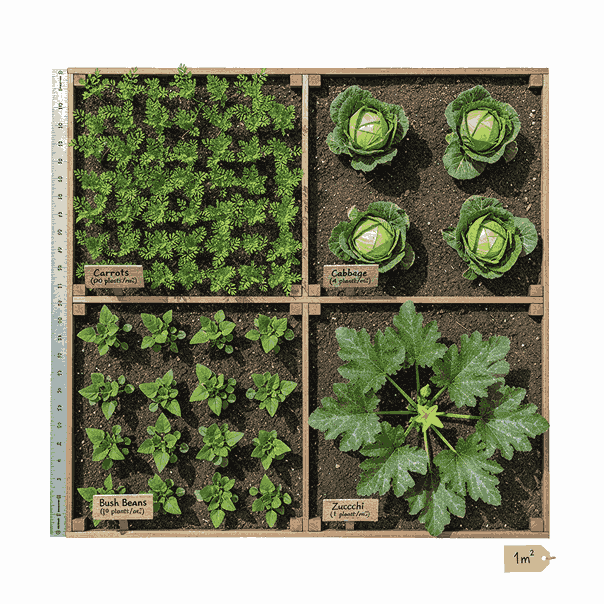
Picture a square in your garden that’s one meter on each side. That’s a square meter.
Plants per square meter just means how many you can grow in that space without crowding them.
Some plants stay small, so you can plant a lot of them close together. Bigger plants need more room, so you might only fit two or three in the same space.
This is often called planting density, but it simply means how close your plants are to each other.
This matters for any garden, big or small, because knowing the right spacing helps your plants grow well and stay healthy.
How to Calculate Plants per Square Meter
Here’s a simple formula you can use:
Plants per square meter = 1 divided by (spacing length times spacing width)
Examples That Actually Make Sense
For example, if you’re planting something that needs 30 cm between each plant in both directions,
You would do: 1 divided by (0.3 times 0.3) = 1 divided by 0.09 = about 11 plants per square meter.
Here’s another example. What if your plants need 60 cm of space, like big tomatoes?
1 divided by (0.6 times 0.6) = 1 divided by 0.36 = about 2.8 plants per square meter.
So, you can fit about 3 plants. That makes sense, right?
Quick tip: If you use inches instead of centimeters, remember that 1 inch is about 2.5 centimeters, and 1 meter is about 39 inches.
Spacing Rules for Different Plants
Different plants need different amounts of space. A small lettuce plant needs much less room than a big pumpkin plant. It’s pretty clear when you think about it.
Small Vegetables and Leafy Greens
Lettuce, spinach, arugula, and carrots are examples of small plants.
You can plant them fairly close together. Usually, 15 to 20 cm apart is enough. This means you can fit about 16 to 25 plants in one square meter. That’s a lot for a small area!
When you first plant lettuce seedlings, they look tiny and far apart. But after three weeks, they’re touching each other. Plants often grow bigger than you expect.
Medium-Sized Vegetables and Herbs
This group includes basil, peppers, bush beans (the kind that don’t climb), and similar plants.
These need more space. Usually, you should leave 30 to 40 cm between each plant.
That means you can fit about 6 to 11 plants per square meter. Still a good amount.
Bush beans stay compact, which is helpful. Peppers, though, can get quite bushy under good conditions. So, don’t plant peppers too close together, or they’ll struggle.
Large Plants and Vining Vegetables
These plants need a lot of space. Big plants like tomatoes, cucumbers, squash, and pumpkins sometimes need 60 cm to a full meter between each plant. You might only get 1 to 4 plants per square meter. Sometimes even less with really big vining plants.
Here’s a helpful tip: If you use a trellis or stakes, especially for tomatoes, you can plant them a bit closer together because they’ll grow upward rather than spread out.
Flowers and Ornamental Plants
Flowers vary widely in spacing needs.
Small flowers like marigolds or petunias can be planted 20 to 30 cm apart. That’s about 11 to 25 per square meter.
Larger flowers like sunflowers or dahlias need much more room to grow, sometimes 50 cm or more between each plant.
The easiest way is to check the seed packet or plant tag. It usually tells you exactly how much space that plant needs, so you don’t have to guess.
Plant Spacing Charts You Can Actually Use
Charts make it easier to see how much space different plants need. Here are some common plants and their spacing requirements.
Vegetables
| Plant Type | Spacing | Plants per m² |
| Lettuce | 20 cm × 20 cm | around 25 |
| Spinach | 15 cm × 15 cm | around 44 |
| Carrots | 5 cm × 15 cm | around 133 |
| Radishes | 5 cm × 5 cm | around 400 |
| Bush Beans | 15 cm × 15 cm | around 44 |
| Peppers | 40 cm × 40 cm | around 6 |
| Tomatoes | 60 cm × 60 cm | around 3 |
| Cucumbers | 50 cm × 50 cm | around 4 |
| Squash | 90 cm × 90 cm | around 1 |
Carrots are a good example: you can fit 133 of them in one square meter because they’re so slim. Radishes can be planted even closer together!
Herbs
| Herb | Spacing | Plants per m² |
| Basil | 25 cm × 25 cm | around 16 |
| Parsley | 20 cm × 20 cm | around 25 |
| Cilantro | 15 cm × 15 cm | around 44 |
| Oregano | 30 cm × 30 cm | around 11 |
Flowers
| Flower Type | Spacing | Plants per m² |
| Marigolds | 20 cm × 20 cm | around 25 |
| Petunias | 25 cm × 25 cm | around 16 |
| Zinnias | 30 cm × 30 cm | around 11 |
| Sunflowers | 60 cm × 60 cm | around 3 |
These are good guidelines to begin with. Your exact numbers might change a bit depending on the variety you’re growing, but this gives you a strong starting point.
Why Plant Spacing Changes
These numbers aren’t set in stone. Sometimes you need to adjust based on your specific situation.
Plant size at maturity: Some varieties of the same plant are bigger than others. Cherry tomatoes are way smaller than beefsteak tomatoes. The bigger ones need more space.
Growth habit: Does it grow straight up, or does it spread out everywhere? Vining cucumbers take up way more room than bush cucumbers. Same plant type, totally different spacing.
Sunlight and airflow: Plants need good air circulation to prevent disease. And they need sunlight reaching their leaves. If you plant too close, the plants in the middle get shaded and don’t do well.
Your goals: Are you trying to get the maximum harvest? You might pack them a bit tighter (but not too tight). Want nice looking, easy to maintain plants? Give them more breathing room.
You have to think about what matters most for your garden.
Common Spacing Mistakes
Here are some mistakes people make all the time when spacing plants.
Overcrowding: This is the biggest one. You get excited and plant everything really close together. Then the plants fight for water and nutrients, air can’t move around them, diseases spread fast, and some plants can’t get any sunlight at all.
Many first-time gardeners do this with tomatoes. By mid-summer, everything is a tangled mess, and half the plants get sick.
Forgetting about row spacing: There’s spacing between plants in a row, and then there’s spacing between the rows. You need both. You need to be able to walk in there, water things, and harvest your vegetables. Don’t forget to leave yourself room to work.
Not planning for adult size: Baby plants look so tiny. It’s really easy to think they’re fine close together. But in a month, they’re huge and crowding each other out.
Always plant based on how big they’ll be when fully grown, not how big they are as seedlings.
Ignoring vertical growth: If you’re using trellises or stakes, you can plant closer together. But you actually have to put up the support structures. Don’t just plant them close and hope it works out.
Helpful Tools and Resources
You don’t need to calculate all this yourself every single time.
Online spacing calculators: Type in your plant spacing, and it tells you how many plants fit. Really simple.
Hedge plant spacing calculator: If you’re planting hedges or privacy screens, a hedge plant spacing calculator is super helpful. Hedges are different from regular garden plants because you want them to grow together into one solid wall of green. Most hedge plants need to be 30 to 60 cm apart, depending on how fast you want full coverage. A calculator made specifically for hedges takes the guesswork out of figuring out how many plants you need for your fence line or border.
Garden planning apps: There are phone apps that let you design your garden layout and help you figure out spacing. Some are free.
Printable charts: Find charts online that list spacing for tons of different plants. Print one out and keep it handy. Way easier than remembering all these numbers.
Seed envelopes: Honestly, just look at the seed envelope. Chances are that the info regarding spacing is right on the back of the envelope. That’s where you should start.
Conclusion
With a basic understanding of plant spacing, the process of determining how many plants can fit in a square meter becomes rather easy. It’s all about knowing the spacing requirements of each plant, some basic math calculations, and referring to graphs in case you’re not sure.
All plants do not grow in the same manner. Some plants, such as lettuce, can be grown close together, while other plants, such as tomatoes, require enough space to spread out. This is not arbitrary. It ensures good air and sunlight circulation.
There is the temptation to fit as many plants as possible when you are really keen and ready to go gardening. However, you must provide enough space for your plants, and this really impacts the growth and the yields that you receive.
Therefore, what are you going to plant this season? Spaced correctly, you will be amazed at just how healthy your plants appear and how much you will be harvesting.
Leave a Reply